
Gold Ducat – History, Value and Types
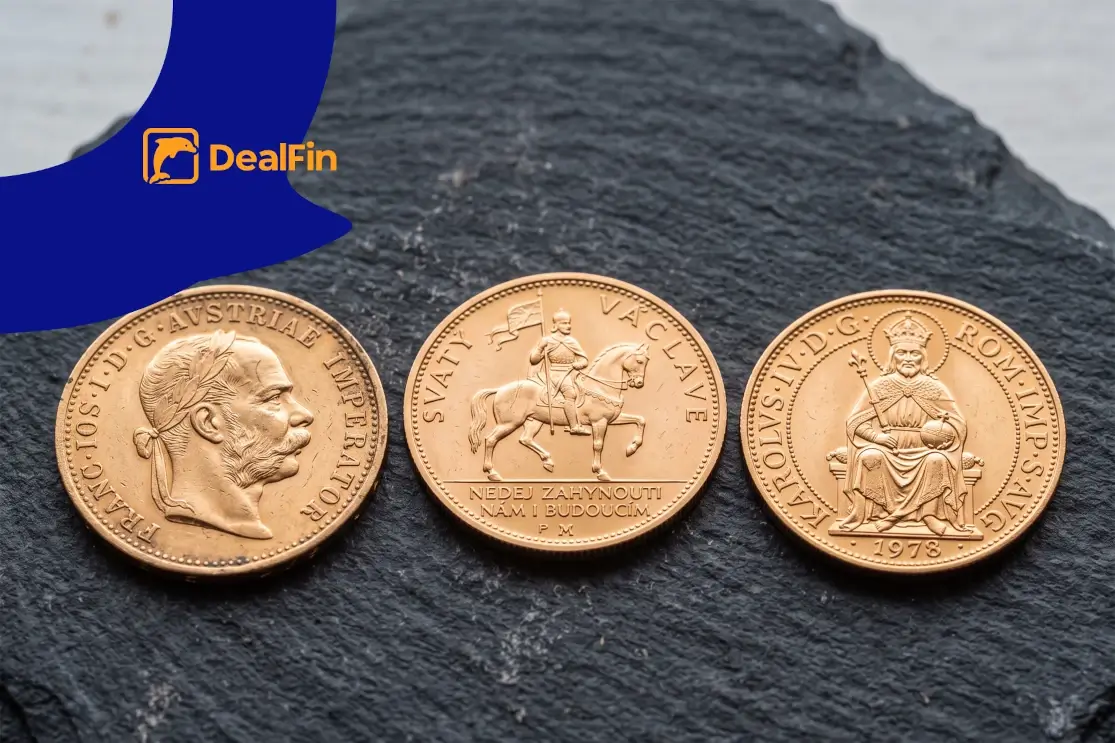
A gold ducat has been an absolute symbol of prestige, stability, and Central European gold wealth for centuries. Whether you are interested in it as a passionate collector, a small investor, or are considering an exceptional gift for someone close to you, this article provides a practical overview.
We will explain why these coins remain so sought after even centuries after their creation and explore their fascinating history from the Middle Ages to the present day. You will learn about the main types and how their value is determined.
What Is a Gold Ducat?
Historically and today, the gold ducat is one of the best-known coins, distinguished by exceptionally high fineness. Traditionally, it is made of gold with a fineness of 986/1000 (so-called ducat gold, equivalent to 23.67 carats). The name derives from the Latin word “ducatus,” meaning duchy.
The first gold ducat appeared in Venice, Italy, as early as the 13th century, specifically in 1284. From there, its commercial fame quickly spread throughout Europe. Over time, it became one of the most widespread and trusted gold coins on the continent.
The key to its international success was strict weight standardization — a traditional gold ducat contains approximately 3.44 grams of pure gold, which ensured easy international acceptance.
Technical Parameters of the Ducat
For a gold ducat to function as a reliable international means of payment and store of value, it had to meet precise standards. Below is a table of the key technical parameters:
| Parameter | Value |
| Fineness | 986/1000 (23.75 carats) |
| Weight (single ducat) | 3.44 g of pure gold |
| Weight (four-ducat) | 13.77 g of pure gold |
| Diameter | Usually 20 mm |
| Material | Gold + additives (usually copper) |
You may wonder why the historical gold ducat has a fineness of 986 rather than the maximum 999 thousandths. The main reason is a combination of tradition and practicality. Adding a minimal amount of impurities (most commonly copper) increased hardness and overall resistance to wear during circulation.
Historically, various multiples of this denomination were also minted — the gold four-ducat is very popular, but large ten- and hundred-ducats also existed.
History of the Gold Ducat in the Czech Lands
The Czech lands have an enormous historical legacy in coin production. The wealth of Czech kings always depended on the mining of precious metals and on the prevailing value of gold on European markets.
Gold Ducats of Charles IV (14th Century)
The first Czech gold coins, florins, were minted by John of Luxembourg in 1325. The first Czech gold coins referred to as ducats were then minted under Charles IV. The historical context was entirely logical — Prague was then a center of power of the Holy Roman Empire.
An original gold ducat of Charles IV is now a major historical rarity. However, if you are looking for a beautiful Charles IV gold ducat for your collection, precise restrikes regularly issued by the Czech Mint may be an option.
Ducats under Austria-Hungary (1848–1918)
The reign of Emperor Franz Joseph I brought enormous prestige to gold coins. Collectors seek, for example, the 1890 Franz Joseph I gold ducat. Collectors’ catalogues also frequently mention other gems, such as the 1892 gold ducat, the valuable 1893 gold ducat, or the 1897 Franz Josef gold ducat.
From the perspective of today’s investor, however, the issue dated 1915 is clearly the most important. The Austrian Mint continuously issues these coins as so-called restrikes.
Czechoslovak Ducats (1918–1939, 1948–1951)
With the arrival of the First Republic and independent Czechoslovakia, the tradition fortunately did not disappear. The first Czechoslovak St. Wenceslas ducats were minted in 1923 to mark the fifth anniversary of the founding of Czechoslovakia.
A legend of Central European numismatics and an extremely valuable item is the 1928 Czechoslovak 2-ducat gold coin, whose auction value is difficult for an ordinary buyer to reach.
St. Wenceslas Ducat – the Best-Known Czech Gold Coin
When it comes to a masterpiece of domestic coinage, the gold St. Wenceslas ducat must not be omitted. It is an issue first introduced in 1923 in honor of Saint Wenceslas, the main patron saint of the Czech lands.
Today, the Czech Mint continues this tradition. Historical St. Wenceslas issues were minted as single ducats, two-ducats, five-ducats, and ten-ducats. The composition of current issues varies by issuer and specific year.
The symbolism of St. Wenceslas on the obverse expresses a desire for security, national pride, and protection of property. Historical St. Wenceslas ducats have a fineness of 986/1000. The same fineness is also used for some contemporary ducat issues. Because of its beauty and symbolism, any gold ducat featuring Duke Wenceslas is a very popular gift.
Gold Ducat for a Child’s Birth
Giving a gold ducat for a child’s birth is not only symbolic but also valuable. The family expresses sincere wishes for wealth, good health, and lifelong happiness.
Among the most popular motifs decorating a gold ducat for a child’s birth are figures of Saint Wenceslas, guardian angels, or the child itself in a cradle. The standard weight of such a gift is typically a single ducat (3.49 g), although various bimetal commemorative versions are becoming increasingly popular.
We recommend giving a gold ducat in a protective capsule or case, ideally with a personal dedication. Its lasting investment value is undoubtedly an advantage — a gold ducat can help protect the invested funds from inflation throughout your child’s life.
How Much Does a Gold Ducat Cost?
If you are interested in collector coins and their financial value, you are certainly interested in the price. The final amount for which a gold ducat can be bought or sold is determined by several factors:
- Spot gold price: This is the basic building block of market value.
- Fineness: The historical standard (986) is compared with the modern version (999).
- Historical value: A genuine period original is many times more valuable than a restrike.
- Coin condition: The state of preservation can dramatically change the price.
- Rarity of the year: An exceptional issue such as the 1928 Czechoslovak 2-ducat gold coin far exceeds other years in value.
- Authenticity certification: Officially guaranteed provenance always increases the selling price.
In 2026, a standard single-ducat restrike costs CZK 7,000–15,000 and a four-ducat (e.g. 1915) approximately CZK 30,000–50,000. An original 1915 Franz Josef ducat costs CZK 10,000–25,000 depending on condition, while historical Charles IV ducats are museum rarities worth hundreds of thousands of Czech crowns.
How to Recognize a Genuine Gold Ducat?
A genuine gold ducat can be reliably identified by strict parameters: it must weigh exactly 3.49 g and have a diameter of approximately 20 mm. Authenticity can initially be assessed by weight, dimensions, appearance, and edge execution. More reliable is professional composition testing, for example by XRF, or assessment by a numismatist.
Due to the growing number of modern counterfeits of historical coins, however, the greatest guarantee is purchasing from an authorized dealer or directly from the Czech Mint, which will provide a reliable certificate of authenticity.
Gold Ducat as an Investment
Does it make sense to invest in ducats, or is a classic one-ounce coin better? If you want to compare historical coins with purely investment-oriented ones, read our detailed article analyzing the Krugerrand coin.
Advantages:
- · Strong historical, numismatic, and cultural value.
- · Emotional value of the gift.
- · High fineness (986–999).
- · VAT exemption (if the issue falls into the investment gold category).
Disadvantages:
- · Noticeably higher numismatic premium compared with the spot price of gold on the exchange.
- · Slightly lower international liquidity than dominant investment coins such as the Krugerrand.
- · For a complete beginner, there is a risk of confusing a valuable original with an ordinary restrike.
Frequently Asked Questions – Gold Ducat
A classic 1 gold ducat weighs exactly 3.49 grams, with approximately 3.44 grams of pure gold.
The historical and best-known standard for a gold ducat is 986/1000 (or 23.75 carats). Modern commemorative ducats may also be minted from investment-grade pure gold of 999/1000.
The very first gold ducats were minted in Venice, Italy, in 1284.
Giving a gold ducat for a child’s birth symbolizes sincere wishes for future financial security, happiness, and good health throughout life.
As of 2026, an original coin from this period is worth approximately CZK 10,000–25,000 depending on its state of preservation.
An original comes directly from the relevant period and carries a significant collector premium. A restrike is a fully legitimate coin struck from genuine gold with a historical design and a fixed date (often 1915), but it serves the role of a standard investment metal. Its premium is generally lower than that of a rare historical original.
Modern commemorative and investment St. Wenceslas ducats are currently issued by the Czech Mint.
Are you considering buying a gold ducat as a gift or looking for a safe investment haven? Explore our expert articles on investment gold, its prices, and transparent purchasing methods in the ducat category on DealFin.cz. Grow your wealth today.