Diamond: What It Is, Properties, Price and Investment
Diamond is the hardest natural mineral, conducts heat exceptionally well, and when properly cut, interacts with light in a striking way. This combination of physical properties, rarity, and difficult processing has made diamonds a symbol of luxury.
However, not every diamond is colourless, perfectly clear, or suitable as an investment. Two stones of the same weight can have completely different prices because their value depends on cut quality, colour, clarity, origin, and the reliability of the certificate.
Alongside natural stones, lab-grown diamonds are now widely available. They have the same chemical composition but are sold at significantly lower prices.
In this article, we will explain what a diamond actually is, what properties it has, how it is valued, how much a one-carat diamond costs, and why buyers need to distinguish between jewellery and an investment asset.
What Is a Diamond?
A diamond is a crystalline form of carbon. Each atom in its structure is firmly bonded to four others, and this crystal lattice is responsible for the mineral’s exceptional hardness. Natural diamonds formed approximately 150 to 200 kilometres below the Earth’s surface under high pressure and temperature. They were later carried upward by rapid volcanic processes, often through rocks known as kimberlites.
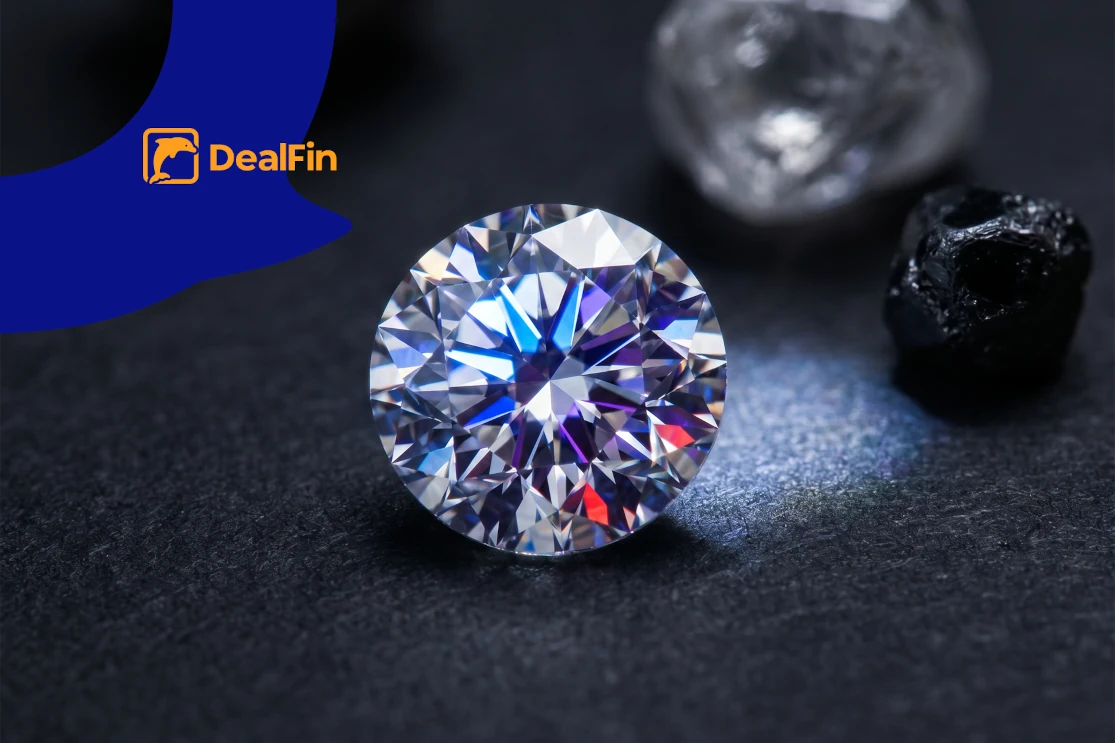
Diamond and brilliant are not synonyms. Diamond refers to the material itself, while a round brilliant diamond is a diamond cut into the classic round brilliant shape. The modern version usually has 57 or 58 facets, which return light to the viewer and create brightness, coloured flashes, and sparkle.
Diamond Properties
| Property | Value |
| Composition | Pure carbon (C) |
| Mohs hardness | 10, the highest |
| Density | 3.5 g/cm³ |
| Refractive index | 2.42 |
| Melting temperature | Approx. 3,550 °C, although diamond is more likely to oxidise or sublimate |
| Thermal conductivity | Very high |
A value of 10 on the Mohs scale means high resistance to scratching, not indestructibility. Diamond is extremely hard but also brittle, and an unsuitable impact can cause it to chip.
Its high refractive index and ability to disperse light create brightness and coloured flashes after proper cutting. These flashes are commonly referred to as fire.
How Is a Diamond’s Value Determined? The 4Cs
The 4Cs system describes four key quality parameters. The standardised grading system was introduced by the Gemological Institute of America, GIA, and helps buyers compare diamonds using the same basic criteria.
| Criterion | English Term | What It Means |
| Carat | Carat | Diamond weight |
| Cut | Cut | Quality of cutting and proportions |
| Colour | Colour | From colourless to yellow |
| Clarity | Clarity | Presence of inclusions |
Carat does not determine a diamond’s size, price, or quality. It measures weight only. Two 1-carat diamonds therefore do not necessarily look the same size or cost the same amount.
Cut affects how much light is returned to the viewer. Colour is graded from colourless grade D to light yellow or brown grade Z, while clarity evaluates imperfections and inclusions under ten-times magnification.
The price of a diamond is determined by the combination of all these criteria. A rare natural colour, verified origin, or high-quality certificate can increase its value. At the same time, a heavier diamond with a poor cut may cost less than a smaller stone with greater visual brilliance.
Types of Diamonds by Colour
Diamonds can differ significantly in colour. The most familiar categories include colourless, black, pink, blue, yellow, and green diamonds.
Colourless Diamonds
For classic diamonds, the less visible colour they contain, the more highly they are generally valued. Grades D to F are considered colourless, while G to J are classified as near-colourless.
They are often set in platinum or white gold because the light-coloured metal does not interfere significantly with their appearance.
Black Diamond
A black diamond is opaque, and its colour can result from dark inclusions or from treatment using heat or radiation. Natural carbonado is a porous material made up of many tiny diamond crystals.
The price of a black diamond depends largely on its origin. Treated stones may cost relatively little, while a rare natural and certified black diamond can be worth many times more.
Pink and Blue Diamonds
Natural pink and blue diamonds are among the rarest varieties.
Pink colour is associated with changes in the crystal lattice, while blue colour is usually linked to the presence of boron. Intense colour combined with confirmed natural origin can push the price of these stones into extremely high ranges.
Yellow and Green Diamonds
Yellow colouring is generally caused by the presence of nitrogen. Yellow diamonds are usually more widely available than pink or blue stones, although individual examples can still be highly valuable.
A rare natural green colour is often associated with exposure to radiation within the surrounding rock.
How Much Does a Diamond Cost?
There is no single answer to the question of how much a diamond costs. A 1-carat diamond of standard commercial quality may cost anywhere from CZK 80,000 to CZK 200,000. A top-quality stone can cost significantly more.
The average retail price of a natural diamond in May 2026 was approximately CZK 96,000. A comparable lab-grown diamond was around CZK 16,000.
These figures are only indicative and may not include the jewellery setting, jeweller’s work, retailer margin, Czech VAT, or insurance. Diamond prices also do not rise in a straight line. A 2-carat stone of the same quality usually costs more than twice as much as a 1-carat diamond because large, clean crystals are rarer. Certification, fluorescence, shape, polish, symmetry, and origin also play an important role in determining the final diamond price.
Rough vs. Cut Diamond
A rough diamond is a crystal before cutting and polishing. It may look dull, irregular, and very different from the finished stone seen in jewellery. The price of a rough diamond depends largely on its potential yield. Based on its shape, cracks, and inclusions, the cutter estimates how large and how valuable the finished stone may become.
Some weight is lost during cutting, but properly shaped facets can significantly increase both the optical and commercial value of the stone.
Not every cut diamond is a round brilliant diamond. Oval, princess, and cushion cuts have different shapes and facet arrangements. The price of a brilliant-cut diamond depends on its weight, quality of workmanship, and the individual 4C parameters.
Natural vs. Lab-Grown Diamond
A synthetic, or lab-grown, diamond is not an imitation. It has the same chemical structure and almost identical physical and optical properties as a natural diamond.
Lab-grown diamonds are produced mainly using two methods. HPHT recreates conditions of high pressure and high temperature, while CVD grows the diamond from carbon-containing gas inside a vacuum chamber.
The main differences are origin, rarity, and price. Average market figures from 2026 show that the price of a 1-carat synthetic diamond can be around 30 to 70% lower than that of a natural diamond.
It is very difficult to reliably distinguish the two types with the naked eye. Professional equipment is needed to examine internal growth structures and other diagnostic features. When buying a more valuable stone, request a GIA or IGI report that clearly states whether the diamond is natural or laboratory-grown.
Investment Diamonds: Are They Worth It?
Investment diamonds can store a high amount of value in a very small physical space, require no special storage conditions, and do not wear out in normal storage. However, prestige and durability do not guarantee a return.
They may make more sense in the case of rare natural stones with strong certification and a long-term investment horizon.
One major disadvantage is the absence of a single transparent market price. Every diamond is unique, so its resale value depends on professional appraisal, the buyer, and current demand. Investors also need to account for a potentially large gap between purchase and resale prices, lower liquidity, and the cost of authentication.
An expensive engagement ring is therefore not automatically an investment simply because the original purchase price was high.
Compared with gold, diamonds are less standardised and more difficult to sell. Gold has a publicly quoted spot price and a broad network of dealers and buyback services. With diamonds, a seller usually needs to find a buyer for one specific stone.
Diamond investment can complement the portfolio of an experienced investor, but for most people, investment gold remains more liquid and easier to value.
How to Tell If a Diamond Is Real
Home tests can provide an initial clue, but they cannot guarantee 100% accuracy.
For example, during a breath test, a diamond will usually clear condensation relatively quickly because of its high thermal conductivity. However, moissanite can behave in a similar way.
A loose diamond will normally sink in water, but so will many imitations. Regular-looking facets under a loupe are not proof of authenticity either.
Cubic zirconia is softer, heavier, and much cheaper. Moissanite has strong brilliance, and some thermal diamond testers may mistake it for diamond.
The most reliable method is examination by a gemologist together with verification of the certificate number. For expensive stones, do not rely solely on home tests or on the seller’s word.
Frequently Asked Questions About Diamonds
The 4Cs evaluate carat weight, cut, colour, and clarity. Together, these parameters determine the quality and price of a diamond.
The price of a natural 1-carat diamond can range from tens of thousands to lower hundreds of thousands of Czech crowns. Standard commercial-quality stones may cost approximately CZK 80,000 to CZK 200,000, but the final price depends on all 4C parameters, certification, and origin.
Intense red, pink, and blue natural diamonds are among the rarest. Their actual value also depends on colour intensity and evenness, clarity, weight, and origin.
A diamond is a mineral made of carbon. A round brilliant diamond is a diamond cut into the classic round brilliant shape designed to maximise brightness, sparkle, and coloured flashes.
Gold is more transparent in terms of pricing and generally more liquid. A diamond requires professional valuation, reliable certification, and usually a longer investment horizon. Finding a buyer for a specific stone can also be more difficult, so gold has an advantage when liquidity matters.
Looking for a stable way to invest in durable physical assets? Explore our articles about investment gold, current gold prices, and how to buy gold bars and coins.