Rhodium Is Among the World’s Most Expensive Precious Metals
Rhodium has at times cost more than ten times as much as gold. Yet most people know it only indirectly: from automotive catalytic converters or the shiny surface of a white-gold ring. This silvery metal combines rarity with properties that industry finds difficult to replace. However, its high value alone does not make it a good investment.
What is rhodium, and how does it differ from platinum or palladium? It belongs to the same group of metals, but its market is considerably smaller, and its price can react sharply to supply disruptions and changes in demand. Thus, the label “most expensive precious metal” describes a particular market period, not an unchanging property of the element.
In this article, we examine its properties, origin, and applications. We also explain rhodium plating on jewelry, provide rhodium prices per gram and kilogram, and show why buying a bar differs from ordinary gold investing.
What Is Rhodium?
Rhodium is a chemical element with the symbol Rh and atomic number 45. It belongs to the platinum-group metals (PGMs). It was discovered in 1803 by William Hyde Wollaston, who also discovered palladium. Its name comes from the Greek rhodon, meaning rose, because of the rose-red color of some of its compounds.
Properties of Rhodium
| Parameter | Value |
| Chemical symbol | Rh |
| Atomic number | 45 |
| Density | approximately 12.4 g/cm³ |
| Melting point | approximately 1,963 °C |
| Color | silvery white |
| Corrosion resistance | very high |
| Hardness | hard metal; depends on form and processing |
Rhodium is highly resistant to chemical attack, and its shiny surface reflects light. This combination of reflectivity and durability is used in plating jewelry, optical mirrors, and reflectors.
Why Is Rhodium So Rare?
Rhodium occurs in trace amounts. It is obtained mainly as a by-product of processing platinum-group metal and nickel ores. A higher price therefore does not translate into a rapid increase in production; separating the metals requires complex refining.
Primary rhodium supplies in 2025 reached approximately 21.8 tonnes. Recycling automotive catalytic converters added 9.7 tonnes. Total supply was thus 31.5 tonnes; this figure should not be confused with mine production.
South Africa supplied roughly 81% of primary supply. Other sources include Russia, Zimbabwe, and North America, including Canada. Dependence on a handful of regions makes the market more sensitive to operational and power disruptions that may occur from time to time.
Where Is Rhodium Used?
Automotive catalytic converters account for the largest share of consumption. In these devices, rhodium helps convert nitrogen oxides into less harmful substances. The automotive industry accounted for approximately 85% of reported demand in 2025.
Other uses include jewelry surface treatments, chemical catalysts, electrical contacts, and mirrors. Rhodium-platinum alloys are also used to make laboratory crucibles, thermocouples for high-temperature measurements, and glassmaking equipment.
Rhodium Plating and Its Importance for Jewelry
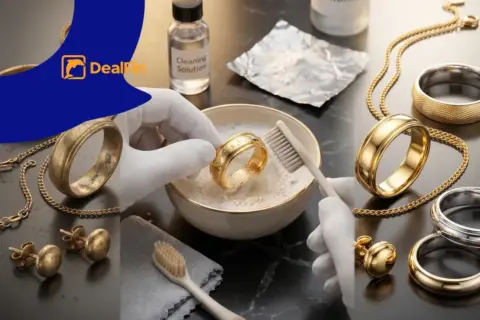
Rhodium plating is the electroplating of a thin layer of rhodium. Cleaned jewelry is immersed in an electrolytic bath, and an electric current deposits the metal onto its surface. It is therefore not the same as making jewelry from solid rhodium.
Thickness depends on the process. For example, the Legor RH2M bath allows layers of 0.02–0.50 μm.
Rhodium Plating of White Gold
White gold is made by alloying gold with other metals that lighten its color. Depending on its composition, it may have a warmer or grayer tone. Rhodium gives it a brighter white surface, but not all white gold must be rhodium-plated.
The layer gradually wears away. A ring worn daily may therefore need replating after 12–24 months, sometimes sooner; jewelry exposed to less wear naturally lasts longer. Surface condition and how the item is worn also matter.
Rhodium Plating of Silver
Rhodium plating helps reduce silver tarnishing. Tarnish is caused mainly by sulfur compounds, which react with silver to form dark silver sulfide. Once the coating wears away, the silver may darken again.
Rhodium Prices and the Reasons for Their Fluctuations
Rhodium prices are influenced by supply, industrial demand, recycling, and inventories. Stricter emissions requirements may support consumption, while more efficient catalytic converters reduce it. The market’s small size contributes to significant price swings.
Physical rhodium is traded primarily over the counter, on the so-called OTC market. Transactions are arranged directly between producers, dealers, and buyers. Published quotations are therefore indicative prices from individual providers and may differ from the offer an investor actually receives.
Historical developments show how dramatically the price can change:
- 2008: The price rose to approximately USD 10,000 per troy ounce.
- 2021: In March, the indicative market quote reached a record of approximately USD 29,800 per ounce.
- 2022–2024: The market underwent a major price correction. A sharp fall in the first half of 2023 was reinforced by sales of surplus inventories held by Chinese glass manufacturers. In 2024, the price stabilized at approximately USD 4,400–4,800 per ounce.
Even extreme rarity does not protect rhodium from a steep price decline.
Rhodium Price per Gram and Kilogram in 2026
As of September 9, 2026, when this guide was written, the price was approximately USD 9,575 per ounce. Using the Czech National Bank exchange rate of CZK 20.813/USD and a troy ounce weight of 31.1034768 g gives the following conversion.
| Unit | Indicative metal value |
| 1 troy ounce | USD 9,575 / CZK 199,284 |
| 1 gram | approximately CZK 6,407 |
| 1 kilogram | approximately CZK 6,407,000 |
This is a conversion of a market quotation, not the retail price of a bar or a guaranteed buyback price. The price of a physical product also includes the dealer’s premium and any applicable VAT. The buyback price, by contrast, may be significantly lower.
Price trends can be followed through Johnson Matthey, Heraeus, or Trading Economics, for example. A similar currency-conversion principle is explained in the article on what determines the value of gold.
Rhodium Compared with Other Precious Metals
| Metal | Indicative price, USD/oz | Primary supply or mine output in 2025 | Main uses |
| Rhodium | USD 9,575 | 21.8 t | automotive catalytic converters |
| Palladium | USD 1,360 | 205 t | catalysts, electronics |
| Platinum | USD 1,890 | 172.9 t | catalysts, jewelry |
| Gold | USD 4,400 | 3,672 t | investment, jewelry |
| Silver | USD 66.6 | 26,332 t | industry, investment |
Prices are rounded quotations from September 9, 2026, not a uniform dealer price list. For platinum-group metals, the table shows primary supplies, which may include changes in producer inventories; for gold and silver, it shows mine production. Recycling is not included.
Rhodium cost approximately twice as much as gold. Its higher price was supported by limited supply and the difficulty of replacing it in catalytic converters. Learn more about a related metal in the article about palladium.
Is Investing in Rhodium Worthwhile?
Investment rhodium may appeal to experienced investors for several reasons:
- Extreme rarity: Rhodium is obtained only in small quantities as a by-product of mining other metals.
- High price per ounce: Even a small amount of rhodium represents substantial financial value.
- Long-term industrial demand: This precious metal is used mainly in automotive catalytic converters.
- Potential to diversify a PGM portfolio: Rhodium can complement platinum and palladium holdings.
However, these properties do not guarantee returns, and the diversification benefit is limited by the metals’ shared dependence on the automotive industry. Before buying, consider in particular:
- Liquidity and spread: Few buyers and a large difference between selling and buyback prices can make it costly to sell rhodium.
- Volatility: The price can rise or fall sharply — money you may need soon should not be invested in it.
- Technological changes: Battery electric vehicles do not need exhaust catalytic converters, but hybrids with combustion engines still use them.
- VAT: Ordinary domestic sales of physical rhodium by a VAT-registered seller in the Czech Republic are subject to a 21% rate. The investment-gold exemption does not apply to rhodium.
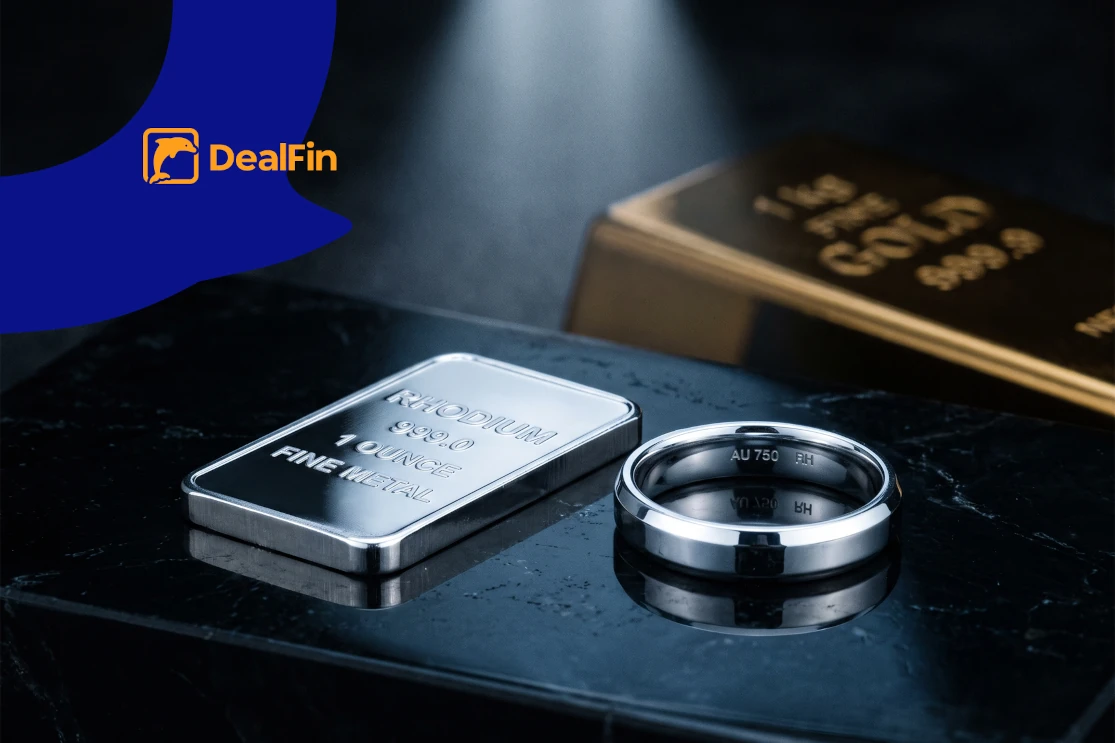
Rhodium bars are offered, for example, by Baird & Co., including a 1 oz bar with 999/1000 purity. Availability is limited; check buyback terms before purchasing.
When buying rhodium, storage in a bonded warehouse or free zone may also be considered if the provider offers this service. For metal imported from outside the EU, the relevant customs procedure may, subject to conditions, defer the obligation to declare or pay import VAT.
There is also Xtrackers Physical Rhodium ETC, a physically backed exchange-traded debt security. It is not the same as an ETF fund; it has its own fees and legal risks. Availability depends on the broker.
Rhodium makes sense, at most, as a small speculative component of a portfolio. For an ordinary precious-metals buyer, investment gold.
Frequently Asked Questions About Rhodium
As of September 9, 2026, yes — approximately twice as expensive. However, the ratio changes over time.
It is a rare platinum-group metal used mainly in automotive catalytic converters and plating.
The indicative quotation on September 9, 2026, was USD 9,575. The price of a bar differs.
Returns cannot be guaranteed. Limited resale options, price swings, and costs make it a risky speculation.
Applying a thin layer of rhodium using electric current to improve appearance and protect the surface.
To achieve a brighter white color and shine. Rhodium plating is not, however, mandatory for white gold.
They are different elements of the PGM group. Their properties, availability, uses, and prices differ.
Considering buying precious metals? Explore the range of investment gold at DealFin.cz.