Collectible Coins – Value, Types, and How to Start Collecting
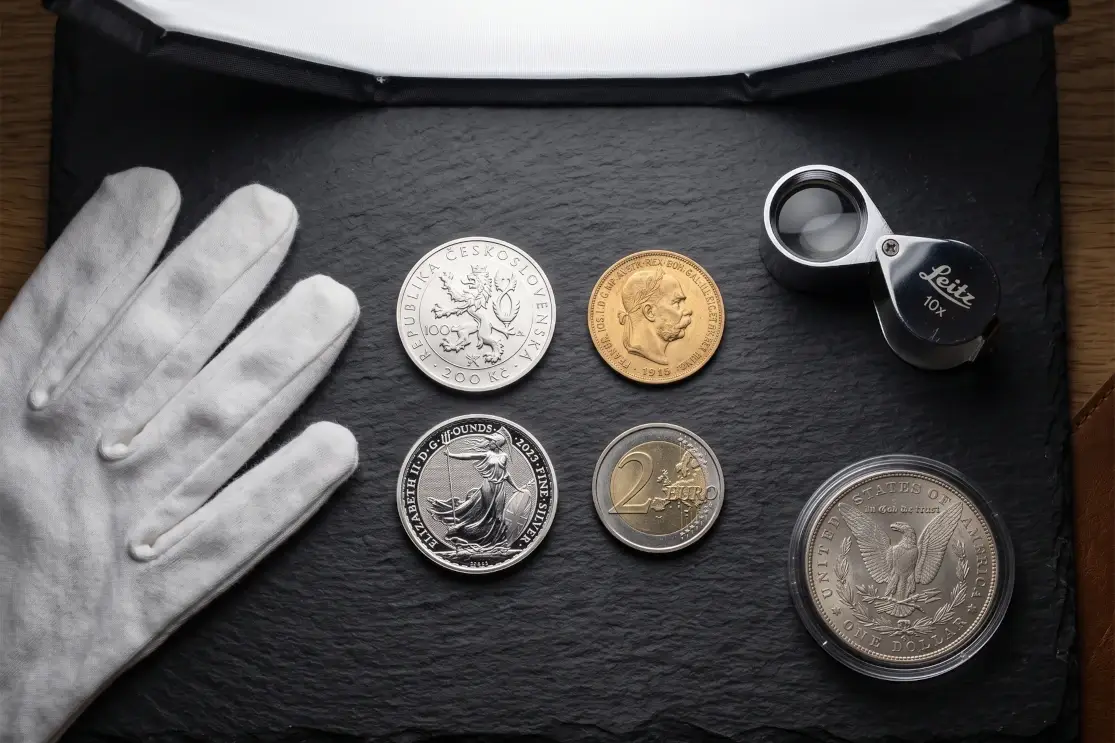
Coin collecting combines history, fine art, and the search for interesting details. Its value is not determined solely by the metal or denomination struck on the obverse. Rarity, mintage, condition, provenance, and market demand also play a role. Some pieces can be purchased for tens of Czech koruna, while others sell for hundreds of thousands at auctions.
Beginners therefore do not need to buy expensive gold right away. A good first collection could consist of Czech circulation coins by year, themed commemorative issues, or pieces inherited within the family. The important thing is to choose a theme, learn how to assess condition, and buy from verified dealers.
Clear collecting rules are what help separate a hobby from impulsive purchases. In this guide, we explain what collectible coins are, how their price is formed, how they differ from investment coins, and how to store them. We also provide a process for building a meaningful first collection.
What are collectible coins?
Czech collectible coins can be historical means of payment, commemorative issues, or ordinary coins that are interesting because of their year or condition. Their price may exceed their face value or metal value due to rarity.
- Circulation coins are used for payment; rare years, varieties, minting errors, or uncirculated pieces can be valuable.
- Commemorative coins commemorate people or events and have legal-tender status.
- Collectible issues are purchased mainly because of their theme, design, and limited mintage. Unlike a coin, a medal does not have a face value.
- Investment coins primarily track the price of the precious metal and generally have a smaller collector premium.
Czech legal-tender coins are issued by the Czech National Bank (ČNB), while minting is carried out by a contracted manufacturer. The Czech Mint also offers its own medals. Planned themes are clearly summarized in the ČNB issuance plan.
Types of collectible coins
Today, you can encounter several types of collectible coins. Let us introduce them.
By material
Material affects the basic value, but it does not determine rarity on its own. A rare copper haléř can be more valuable than a common gold coin.
| Material | Typical fineness or composition | Relationship to price |
|---|---|---|
| Gold collectible coins | 900–999.9/1,000 | high metal value and purchase price |
| Silver collectible coins | 900–999/1,000 | more accessible themed issues |
| Bimetallic coins | two metals or alloys | mainly determined by mintage, condition, and demand |
| Platinum | often 999.5/1,000 | high metal value, smaller market |
| Base metals | copper, nickel, steel, and alloys | low metal value, rarity is important |
Gold collectible coins combine numismatics with the value of the metal. Collectible silver coins are usually more affordable and offer a wide selection of Czech themes.
By face value
Collectible 10 Kč, 20 Kč, and 50 Kč coins may have a higher price depending on the year, variety, and condition. However, most common pieces from circulation remain close to face value.
The Czech 20 Kč coin is not bimetallic: it is made of steel plated with a copper-zinc alloy. Collectors may be interested in the motifs from 2000, 2018, and 2019, or proof coins from official collector sets. The 50-koruna coin, on the other hand, is bimetallic.
ČNB also issues silver and gold commemorative coins with higher denominations, whose selling price is often a multiple of their face value.
By origin and period
You can collect Czech and Czechoslovak coins, Austro-Hungarian issues, as well as modern world issues. Beginners can benefit from a defined theme or category: one country, ruler, denomination, or theme.
How much do collectible coins cost?
There is no single answer to the question of how much a collectible coin costs. Its value is determined mainly by:
- Fineness and material – especially gold, silver, or platinum.
- Issue mintage – a smaller number of pieces can increase rarity.
- Coin condition – an uncirculated piece is usually more expensive than a damaged one.
- Historical value – age, origin, and historical context.
- Demand – current collector interest.
- Certification – verification of authenticity and condition.
An ordinary ten-, twenty-, or fifty-koruna coin from your wallet usually costs only its face value, meaning the value stated directly on it.
Sets of special 20-koruna coins from 2018 and 2019 generally sell for hundreds of koruna depending on condition. For example, such a gold ČNB coin “City of Pilsen” with a face value of 5,000 Kč was offered in proof quality for approximately CZK 58,000–65,000 after its release in May 2026.
Compare completed auction sales, not just listings. For more expensive pieces, use professional appraisal; a difference of several condition grades can multiply the price.
How is coin condition assessed?
Proof and BU describe the method of production, not automatically the condition. Condition is assessed separately.
| Designation | Meaning |
|---|---|
| Proof (PP) | special strike, usually with a polished field and frosted relief |
| BU (Brilliant Uncirculated) | superior uncirculated finish with original mint luster |
| UNC (Uncirculated) | no signs of circulation; may have minor production marks |
| EF (Extremely Fine) | exceptionally well preserved, with only minor signs of circulation |
| VF (Very Fine) | very well preserved, with visible wear on raised areas |
| F (Fine) | well preserved, visible wear, main elements remain legible |
| VG (Very Good) | worn, image remains legible |
| G (Good) | heavily worn |
Grading companies such as NGC and PCGS use the Sheldon scale from 1 to 70. MS 70 indicates a flawless regular-strike coin that has not circulated, while PF 70 indicates a flawless proof.
Collectible coins vs. investment coins
| Criterion | Collectible coin | Investment coin |
|---|---|---|
| Main value | Rarity, condition, history (numismatics) | Precious metal content |
| Fineness | Varies by issue | Usually 916.7–999.9/1000 for gold |
| Mintage | Often limited | Generally higher |
| Price vs. spot | Often significantly higher | Generally closer to the metal price |
| Liquidity | Rather lower, except for well-known collectible gold or silver coins | Generally higher |
| Suitable for | Collectors and numismatists | Precious metals investors |
| VAT in the Czech Republic | Depends on the metal and sales regime | Investment gold is VAT-exempt |
For example, the Krugerrand has a fineness of 916.7/1000, yet it is one of the established investment coins. A historical piece can simultaneously have collector and metal value.
How to start collecting coins in five steps
In this section, we will look together at how you can start collecting collectible coins.
Step 1: Choose your collecting direction
Determine which collectible coins interest you. A collection can be focused by country – for example, Czech, Austrian, or world coins – by period, such as antiquity, the modern period, or the contemporary era, or by theme, such as personalities, anniversaries, or architecture. Another option is collecting by material, especially gold or silver.
Step 2: Study the subject
Work with numismatic catalogs, such as Krause catalogs or Czech specialist publications. Specialist literature and membership in a numismatic club can also help, where you can gain experience from other collectors.
Step 3: Choose reliable sources
Buy new coins from trustworthy sources. These include ČNB as the issuer of Czech coins, the Czech Mint as their manufacturer, authorized dealers, and established auction houses. For more expensive pieces, always verify authenticity and watch out for counterfeits.
Step 4: Start with a small budget
Learn first and only then invest larger amounts. Start with key pieces from your chosen series and gradually expand the collection. This will help you avoid impulsive and overpriced purchases.
Step 5: Store coins properly
Store coins in special capsules or a high-quality coin collector’s album. Maintain a stable temperature and low humidity. Never touch the surface with bare fingers – hold the coin only by its edge or use clean gloves.
How to store collectible coins?
Protect coins from abrasion, moisture, and fumes. A capsule made of inert plastic, a frame without plasticizers, or a high-quality coin collector’s album is suitable. Store a more valuable collection in a safe and take photographic documentation.
The environment should be dry, dark, and stable, with humidity of approximately up to 50%. Handle the coin by its edge while wearing clean gloves. Do not polish the surface: removing the patina can reduce its value. The principles of care are summarized in the article How to Clean Gold at Home, but for a valuable coin, the procedure should be left to a professional.
Frequently asked questions
Collectible coins gain value primarily through rarity, mintage, condition, and collector interest. For investment coins, the main factors are the amount and current price of the precious metal.
The price can range from tens of koruna to hundreds of thousands. It is influenced by rarity, condition, material, mintage, origin, and current demand. Therefore, a coin’s face value does not necessarily correspond to its collector value.
ČNB mainly issues silver and gold commemorative coins dedicated to important personalities, events, institutions, and monuments. It also occasionally issues circulation coins with special motifs.
Choose a specific country, period, theme, or material. Study catalogs, set a budget, and buy your first coins only from trustworthy dealers.
New Czech coins can be purchased from ČNB’s contractual partners, the Czech Mint, and specialized dealers. Older coins are offered by numismatic shops and established auction houses.
Store coins in capsules or numismatic albums in a dry environment with a stable temperature. Do not touch their surface with bare fingers and never clean them without professional assessment.
Considering investing in precious metals instead of collecting? Take a look at our articles about investment gold, its prices, and ways to purchase bars and coins on DealFin.cz.