Gold Reserves — How Much Gold Does the CNB and the World Hold?

Central banks are buying gold at an absolutely record-breaking pace today. The Czech Republic is among the most active countries in the world. Gold reserves are not only of interest to macroeconomists; they are also an important signal for individual investors.
This article reveals the latest CNB figures, a detailed ranking of countries by gold reserves, and historical context. You will also learn why central banks are accumulating precious metals on such a large scale today.
Let us take a closer look at CNB gold and global gold reserves.
How Much Gold Does the CNB Hold?
The Czech National Bank currently holds approximately 84.1 tonnes of gold in 2026. Its board is firmly targeting the landmark 100-tonne threshold, which it aims to reach by 2028 at the latest. If you are wondering how many kilograms of gold the CNB has, the figure is almost 85,800 kilograms.
Since 2023, the CNB has purchased gold at a steady rate of around 1.5 to 2 tonnes per month. The Czech Republic’s current gold reserves are therefore the largest in its modern history. They have even surpassed the previous historical record from 1939. CNB gold reserves change every month; verify the figures at cnb.cz.
CNB Gold Reserves — How They Have Grown Over Time
The following table shows how the volume of metal in vaults has changed throughout Czech history.
| Year | CNB gold reserves | Event |
| 1939 | 96.6 tonnes | historical record (followed by wartime losses) |
| 1993 | ~70 tonnes | federation split, beginning of sales |
| 1998–2021 | ~10–14 tonnes | low after 1990s sell-offs |
| 2023 | ~30+ tonnes | purchasing strategy begins (Governor Michl) |
| 2024–2025 | 50–70 tonnes | systematic purchases |
| 2026 | 85.8 tonnes | toward 100 tonnes |
The current purchasing strategy began under Governor Aleš Michl. The 100-tonne target primarily aims to improve the diversification of foreign exchange reserves and protect against global economic fluctuations. CNB gold reserves thus strengthen the portfolio’s long-term stability.
Who Sold the Czech Gold Reserves in the 1990s?
The question of who sold the gold reserves of the state at that time remains highly emotional for many people. After the federation split with Slovakia in 1993, the Czech Republic retained approximately 70 tonnes. In the second half of the 1990s, however, the institution decided to sell 56 tonnes.
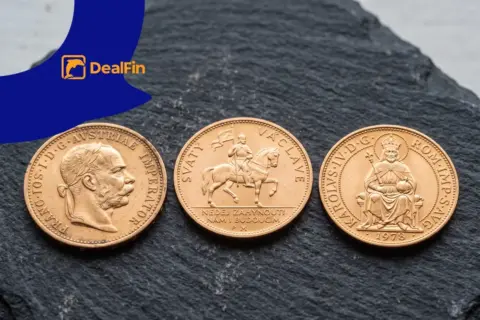
The proceeds of that sale were subsequently exchanged for foreign bonds. From today’s perspective, with the metal’s price several times higher, this historical decision proved disadvantageous. The legendary St. Wenceslas gold ducat also represented a similar loss of value at the time. Today’s strategy has therefore reversed completely.
Where Does the CNB Store Its Gold?
Wondering where the CNB actually stores its gold? Some of it is naturally held in the CNB’s secure vaults in Prague. A significant portion, however, is strategically stored in foreign depositories, particularly at the Bank of England in London.
The main reason for storage in London is its enormous liquidity and the ability to trade immediately. Banks can manage gold there with ease. CNB gold reserves are also regularly subject to strict international audits, ensuring the absolute security of all national reserves.
Ranking — Which Countries Have the Largest Gold Reserves?
If you are interested in national gold reserves, take a look at our updated ranking. The 2026 figures are based on WGC and TradingEconomics data.
| Rank | Country | Gold reserves | % of foreign exchange reserves |
| 1. | USA | ~8,133 tonnes | ~70% |
| 2. | Germany | ~3,351 tonnes | ~70% |
| 3. | Italy | ~2,452 tonnes | ~65% |
| 4. | France | ~2,437 tonnes | ~65% |
| 5. | China | ~2,300+ tonnes | ~4.6% |
| 6. | Russia | ~2,280 tonnes | ~25% |
| 7. | Switzerland | ~1,040 tonnes | ~8% |
| 8. | India | ~881 tonnes | ~9% |
| 9. | Japan | ~846 tonnes | ~4% |
| 10. | Poland | ~632 tonnes | ~15% |
| 41. | Czech Republic | 84.1 tonnes | target: 5–10% |
Individual investors also purchase investment metals alongside central banks. They often choose popular gold coins such as the Krugerrand or Vienna Philharmonic.
Among the largest sovereign buyers today are China, Poland, and the Czech Republic, which is particularly active in purchasing gold. Interestingly, Italy currently has larger gold reserves than Russia, among other countries.
The International Monetary Fund (IMF) and European Central Bank (ECB) are also among the world’s most significant institutional holders of gold.
Why Do Central Banks Buy Gold?
The main reason for massive purchases is the drive toward de-dollarization, meaning a strategic shift away from the US dollar. For example, from 2022 to the present, central banks have purchased record quantities of gold, exceeding 1,000 tonnes annually.
Gold reserves therefore provide reliable diversification. One advantage is that this precious metal carries no counterparty risk, since gold is not anyone else’s direct liability.
Precious metals also provide exceptionally strong protection against global inflation and crises. Geopolitics plays a major role, as it strongly influences the value of gold. The freezing of Russian reserves in 2022 was a clear warning to other central banks that even foreign exchange reserves can become inaccessible overnight.
Gold Reserves Chart — How to Track Developments
Looking for a gold reserves chart? We recommend following official statistics directly on the CNB website, where transparent monthly reports are available. Other valuable analytical data are provided by World Gold Council and IMF IFS.
We always supplement the article with a simple chart showing the current development of the Czech central bank’s reserves. This static image, marked with its update date, clearly illustrates the steady pace at which CNB gold is approaching 100 tonnes.
What Does This Mean for an Ordinary Investor?
Central banks represent so-called “smart money.” Their massive purchases send a clear signal to the market. If the CNB is successfully building its huge national reserve, establishing your own private reserve also makes great sense.
A general economic rule recommends holding 5–15% of a long-term portfolio in physical gold. The difference is only in volume. While the bank buys tonnes, CNB investment gold inspires ordinary investors to accumulate grams. Find out in our guides how to invest in gold and, above all, where to buy investment gold of the highest purity.
Frequently Asked Questions — Gold Reserves
The CNB currently holds approximately 84.1 tonnes in 2026. The bank’s main goal is to reach 100 tonnes by 2028 at the latest.
The United States has by far the largest holdings worldwide, with approximately 8,133 tonnes of gold.
Part of the reserves are held in Prague, while another part is strategically located at the Bank of England in London for its high liquidity.
The sale of approximately 56 tonnes was carried out directly by the Czech National Bank as part of its portfolio adjustment at the time.
Gold is ideal for diversifying national foreign exchange reserves and serves as protection against rising inflationary and geopolitical risks.
No, the bank does not sell CNB investment gold or any other bars directly to the public. Verified dealers such as DealFin.cz provide secure purchasing options.
Central banks are building their gold reserves very actively — so make a smart decision and build yours too. Browse our available investment bars and coins. Start with as little as 1 gram and create a reliable private reserve securely with DealFin.cz.