
ETF gold, what it is, how it works and how it differs from physical gold
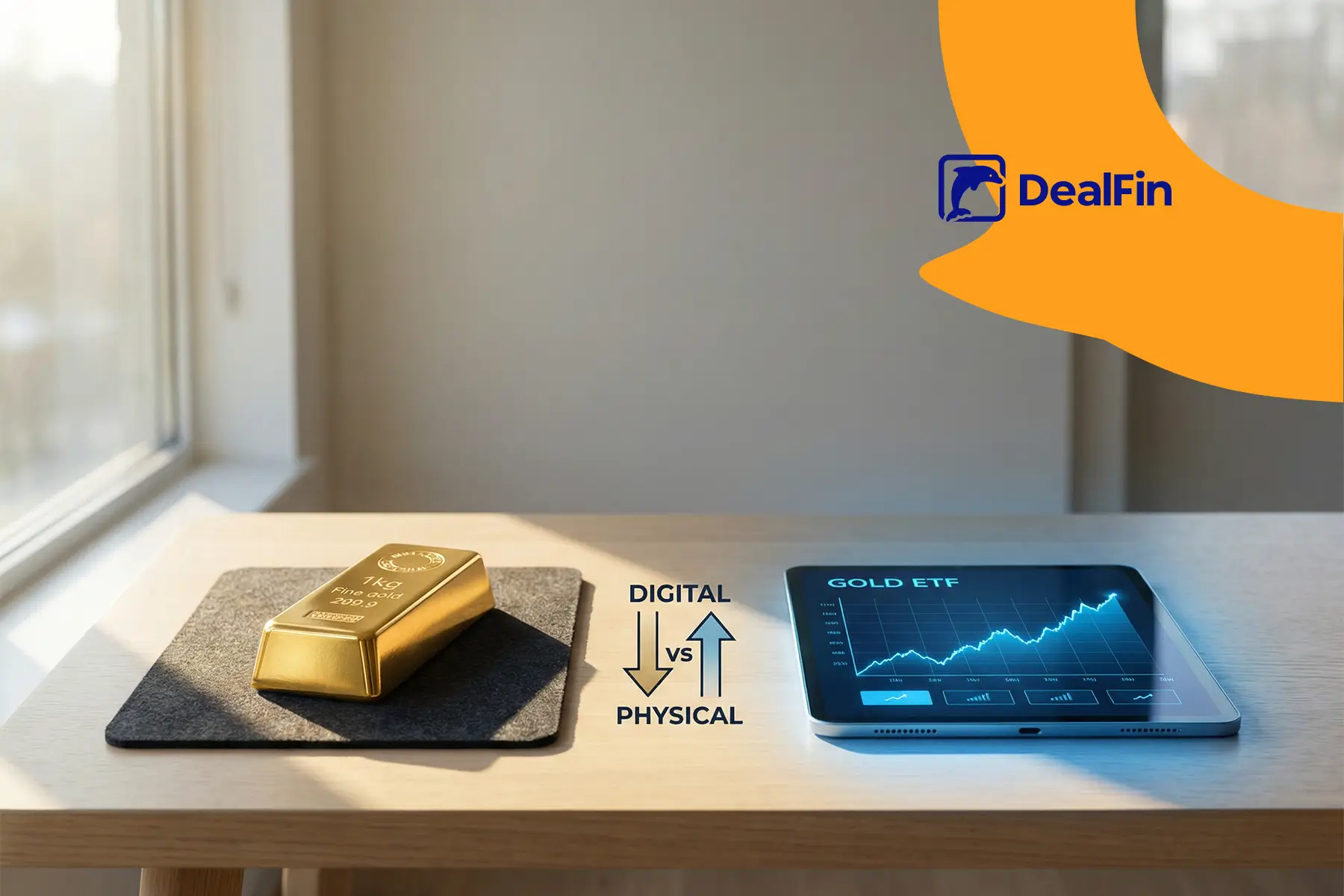
Today, gold can be bought not only in physical form, but also through so-called exchange-traded funds, known by the abbreviation ETF. In this case, you get ETF gold through “paper exposure”, meaning you become the owner of a share in this fund recorded in the securities register or shareholder register.
This approach is therefore very different from buying physical gold in the form of a bar. For gold investors, however, both options can bring certain benefits, but also risks that are good to know about from the very beginning.
In this guide, we will therefore focus on the differences between investing in physical gold and ETFs linked specifically to this precious metal and its value on the stock exchange.
What is ETF gold and how does it work
A gold ETF, Exchange Traded Fund, represents a modern and efficient way to invest in this precious metal without having to hold physical bars and deal with their storage or security.
Every ETF on gold can be found on a classic exchange, such as the NYSE or NASDAQ. Its main goal is to copy the current market price of gold as accurately as possible. To faithfully track the value of the precious metal, the fund uses 2 different approaches.
- The first are physically backed ETFs, such as iShares Physical Gold ETC. These funds use investors’ money to actually buy and safely store real gold bars. You therefore own a security that is safely backed by real physical metal.
- The second option is synthetic funds. These institutions do not hold physical gold in their vaults at all. Instead, they use financial derivatives and swap agreements with investment banks to precisely replicate the market movement of the gold price. This approach, however, may carry a slightly higher counterparty risk than the traditional physically backed alternative.
Trading gold ETFs itself is extremely simple today and works exactly the same way as trading regular stocks. You do not have to deal with renting safety deposit boxes or expensive insurance for this precious metal. To invest, all you need is access to an online broker, through which you can place your order from the comfort of your home.
Your transaction is then executed on the global exchange literally within seconds. This gives you a highly liquid asset that you can sell back into cash at any time during trading hours.
Gold ETFs therefore form an ideal and low-cost tool for effectively protecting and diversifying your investment portfolio. But of course, they also have their risks and differences from traditional ownership of physical gold.
ETF gold vs. physical gold bars, comparison
| Feature | ETF gold | Physical gold |
| Ownership | Indirect, you hold a security, there is no physical ownership, counterparty risk exists | Direct, you own and fully control real coins or bars |
| Liquidity | Immediate. Can be sold within seconds during exchange trading hours | Lower. Requires finding a buyer, verifying authenticity and physically handing over the metal |
| Fees | Very low ongoing costs, TER usually around 0.12–0.25% | Higher entry costs due to dealer margins and processing premiums |
| Taxes | Tax regime is the same as for classic securities | Investment gold is fully exempt from VAT by law |
| Storage | Completely worry-free. You pay no storage costs or additional insurance | Need to ensure safe storage, home safe or rented safety deposit box |
| Access during a crisis | You are fully dependent on brokers, the exchange and internet connection working | Independence from the financial system. You physically hold the metal yourself |
Fees for ETF gold, what it will really cost you
Every investment costs something, and this is true both for a physical bar and for an ETF on gold. Let’s now break down the fees or costs you are likely to encounter when buying a gold ETF:
- TER (Total Expense Ratio): 0.12% to 0.25% per year for major gold ETFs.
- Broker fee for buying/selling: 0–0.5% depending on the platform.
- Spread: another form of potential broker cost, the difference between the buying and selling price.
- Hidden costs: spread, currency risk.
Many investors especially forget about currency risk, which is not as visible as the other fees mentioned above. To explain what this means, let’s use an example:
- Purchase: you buy a gold ETF in US dollars (USD).
- Price increase: gold rises by 10%, but the Czech koruna also strengthens against the dollar by 10%.
- Result: in koruna terms, your profit is therefore zero.
- Risk: a stronger koruna erases gains from the rising gold price or deepens possible losses.
Tax aspects of ETF gold in the Czech Republic
Investments in gold ETFs are treated in the Czech Republic, from a tax perspective, as a classic purchase of securities, meaning stocks. Therefore, on any profit from a sale, you normally pay income tax at a rate of 15%. This tax obligation can be avoided if certain conditions are met, such as:
- The time test for full tax exemption for ETFs is exactly 3 years. If you hold the fund shares longer, you do not tax the profit.
- The exemption also applies if your total income from selling all securities does not exceed the limit of 100,000 CZK per year.
Physical gold in the form of investment bars and coins, on the other hand, is classified under Czech legislation as movable property. What is very important here is that it is exempt from VAT and also from income tax.
When comparing both approaches, the tax advantage of physical gold in the Czech Republic is very significant. With ETFs, you must carefully monitor legal limits and the three-year period, while income from selling real metal does not burden your tax return in any way.
Who is ETF gold suitable for?
For some investors, however, ETF gold can still be a very suitable option. These include, for example:
- Investors with small capital who do not want to deal with storage.
- Active traders who want to react quickly to changes in the gold price on the market.
On the other hand, physical gold may be preferred by investors who want to invest in this precious metal outside banking and IT systems and who prefer physical assets they can actually touch.
Prefer physical ownership of gold without counterparty risk? We offer certified investment bars from 1 g, with no annual fee and no counterparty risk, plus tax exemption in the Czech Republic. View the offer.
Frequently Asked Questions
A gold ETF is an exchange-traded fund that directly tracks the market price of gold. You buy a security that is either actually backed by bars or secured through financial derivatives. This completely removes any worries and additional costs related to storing the precious metal.
Investing in a gold ETF is done through a regulated online broker, where you can easily open an account. Then you simply place an electronic order to buy the selected fund. The transaction itself is executed on the global exchange almost immediately, within just a few seconds.
Physical gold is something you actually hold in your hand, which gives you independence from the system, but requires solving safe storage. ETF offers a security with immediate liquidity and tiny fees without the need for storage. With funds, however, you always take on a certain risk of possible counterparty failure.
In the Czech Republic, ETF funds are taxed like ordinary securities, stocks, at a 15% rate on the achieved profit. However, you can fully avoid this tax obligation by meeting the 3-year time test. Tax exemption also applies if your annual income from selling securities does not exceed 100 thousand Czech koruna.