Investment Silver vs. Gold, What Pays Off?
Gold and silver are among the oldest forms of storing value. Investment gold is a symbol of stability, certainty and long-term wealth protection, while investment silver attracts investors with a lower price and higher growth potential.
Every beginner investor asks whether gold or investing in silver is better. The answer depends on budget, goal, time horizon and willingness to tolerate fluctuations. Below you will find a comparison, advantages, disadvantages, taxes and strategies.
Silver and Gold, Brief Overview
Investment gold is a traditional store of value. For centuries, it has served as a reserve for states, central banks and private investors. It is rare, easy to transport and easily recognized around the world. That is why people turn to it during inflation, uncertainty or currency crises.
Silver is often called “poor man’s gold”. It is cheaper, more accessible and, besides its investment function, has extensive industrial use. Investing in silver therefore combines wealth protection with speculation on rising demand. Both metals are tangible assets outside the banking system, but they differ in price, volatility, storage and taxes.
Main Differences Between Silver and Gold
| Feature | Gold | Silver |
| Current price per ounce | high | low |
| Price per gram | high | very low |
| Volatility | low | high |
| Liquidity | very high | high |
| Storage space | small volume | large volume |
| VAT in the Czech Republic | 0 % (investment) | 21 % (except exceptions) |
| Industrial use | limited | extensive |
| Growth potential | moderate | high |
| Suitable for beginners | yes | rather no |
| Status symbol | yes | no |
| Silver:gold ratio | 1 | approximately 60:1 in mid-2026 |
Investment silver is cheaper and more dynamic, investment gold is more stable. Gold works well as a foundation, silver as a riskier addition.
Investment Gold, Advantages and Disadvantages
Advantages of Gold
- Value stability, gold has smaller long-term fluctuations than silver.
- High liquidity, gold bars and coins can be sold to dealers around the world.
- Tax advantages, investment gold is exempt from VAT in the Czech Republic and the EU if it meets legal conditions, for example purity above 995.
- Small storage space, high value can be stored in a small volume.
- Status and tradition, investing in gold is a symbol of wealth and trust.
Disadvantages of Gold
- High entry threshold, even one gram costs thousands of crowns.
- Lower growth potential, gold is more stable, but it may not outperform stocks or riskier assets.
- No income from holding, it does not bring interest or dividends.
Investment Silver, Advantages and Disadvantages
Advantages of Silver
- Low entry threshold, investment silver is accessible even for smaller budgets.
- High growth potential, in growth phases silver can strengthen faster than gold.
- Industrial demand, it is used in photovoltaics, electronics, batteries and medicine.
- Strategy, in combination with gold, investing in silver can increase portfolio diversification.
- Availability of coins and bars, the market offers silver coins, silver bars and 1 kg investment silver.
Disadvantages of Silver
- High volatility, price swings of tens of percent are relatively common.
- 21 % VAT in the Czech Republic, a regular investment in silver is subject to VAT.
- More storage space, for the same value you hold a larger volume of metal than with gold.
- Susceptibility to oxidation, physical silver can darken over time.
- Lower liquidity, selling silver can be slower and come with a larger spread.
Gold and Silver Price Ratio (Gold-Silver Ratio)
The Gold-Silver Ratio shows how many ounces of silver are needed to buy one ounce of gold. If the ratio is 60:1, one ounce of gold is worth approximately 60 ounces of silver. In ancient times, the ratio often moved around 1:10 to 1:15, in the 20th century more often around 1:40 to 1:60, and in recent years it has often been higher.
For an investor, the ratio is an indicator of relative price. A high ratio may suggest that investment silver is cheaper relative to gold. A low ratio, on the other hand, shows that silver has already become significantly more expensive and investment gold may be more attractive. The strategy is based on gradually moving part of the portfolio between metals, not on a one-time market guess.
Forms of Investment, Gold vs. Silver
You can invest in both gold and silver in different ways, whether through physical investment bars or coins, or through “paper” assets such as ETFs or shares of mining companies.
Investment Bars
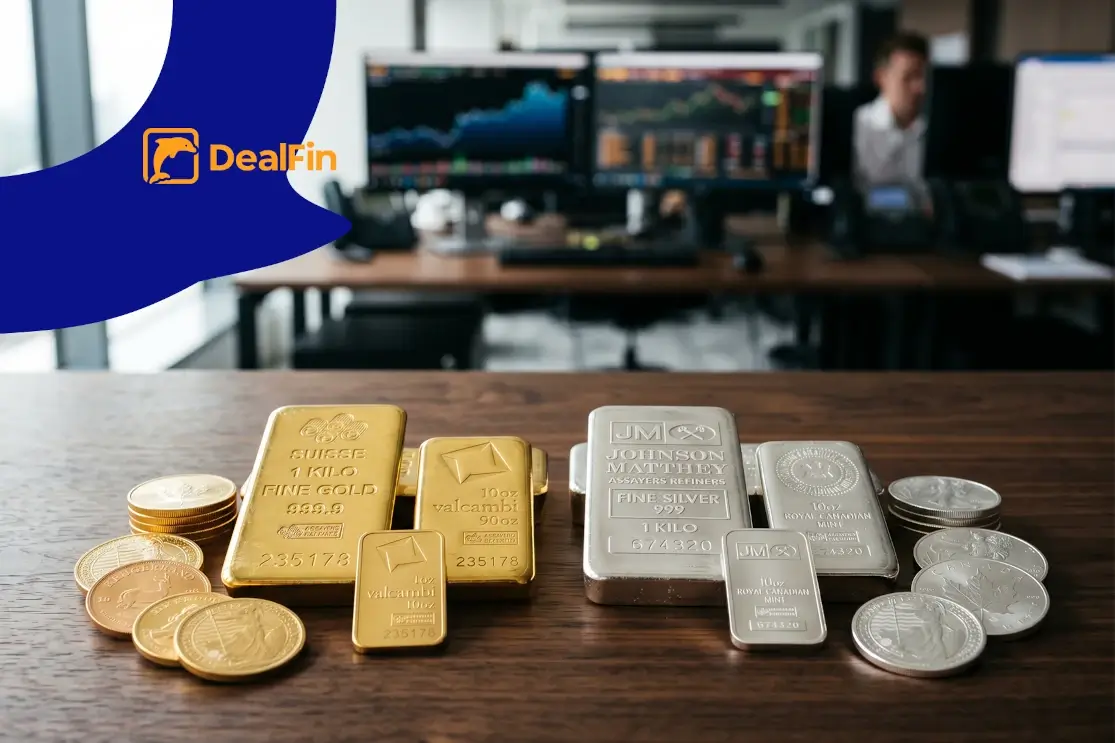
Gold bars are sold from small gram weights up to 1 kg. Larger bars usually have a lower premium over the spot price. Silver bars are often sold from 1 ounce up to 5 kg. 1 kg investment silver is especially popular.
Investment Coins
Gold coins such as Wiener Philharmoniker, Maple Leaf or Krugerrand are among the most popular on the market. For silver, silver coins with the same motifs are popular, as well as American Eagle or Britannia. Each silver coin has the advantage of a lower price, easy division of the investment and collector appeal.
ETFs and Paper Forms
ETFs and other paper forms exist for both metals. They offer easier buying and selling, but the investor does not own the physical metal. That is why they are less popular among people who want a tangible reserve.
Tax Aspects, Gold vs. Silver
Investment gold is exempt from VAT in the EU if it meets the definition of investment gold. This is one of the main reasons why it is often more advantageous for long-term investors than silver. Investment silver in the Czech Republic is usually subject to 21 % VAT, so the price of silver must rise more for the investor to cover the difference between purchase and sale.
For individuals, it is also advisable to monitor income tax when selling and keep invoices. For larger transactions, it is worth checking the current rules with a tax adviser. A silver investor must therefore account for VAT, margin and storage already at the time of purchase.
Who Is Gold Suitable For and Who Is Silver Suitable For?
Investment gold is suitable for:
- Conservative investors who mainly want to protect the value of their wealth.
- People looking for capital protection against inflation, crises and currency uncertainty.
- Beginners in precious metals, because it is easier to understand, store and sell.
- Investors with a higher budget who do not need to buy in small amounts.
- Long-term strategies of 5 years or more.
Silver is suitable for:
- Investors with a lower budget who want to start gradually.
- Buyers with a higher tolerance for risk and willingness to tolerate stronger fluctuations.
- More speculative investors who believe in the growth of industrial demand.
- Supplementing a gold portfolio, because investing in silver can add a more growth-oriented component.
- Investors interested in investing in silver through coins, bars or regular purchases.
Optimal Strategy, Combining Gold and Silver
The most reasonable path is often not choosing only one metal, but combining them.
- A classic ratio can be 70 % investment gold and 30 % investment silver. The portfolio has a stable foundation while still leaving room for silver price growth.
- A 50/50 growth strategy is suitable for investors who believe in silver and accept higher risk.
- A conservative strategy of 90 % gold and 10 % silver is suitable for those who primarily want safety.
With 50,000 Kč, for example, you can buy a smaller gold bar and several silver coins. With 200,000 Kč, it makes sense to combine coins, bars and part of the silver in ounces or kilograms.
Frequently Asked Questions, Investment Silver vs. Gold
For beginners and conservative investors, gold is usually more suitable. Silver is better suited as an addition or a more growth-oriented part of the portfolio.
Investment gold has a special tax regime in the EU. Silver is usually sold as regular goods, and therefore is subject to VAT in the Czech Republic.
The price changes daily depending on the exchange price, the koruna exchange rate and the dealer margin. In 2026, the price of 1 kg of silver is around 47,000 Kč. For accurate data, however, follow the silver price from a specific dealer.
It is the ratio of the price of one ounce of gold to the price of one ounce of silver. It helps roughly determine whether gold or silver is relatively cheaper.
In growth phases, silver can rise faster than gold, but it also falls more sharply. Higher potential is therefore balanced by higher risk.
Planning to invest in precious metals? Read our other articles about investment gold and silver, current prices and ways to buy bars and coins.