Platinum: Precious Metal, Properties, Price and Investment
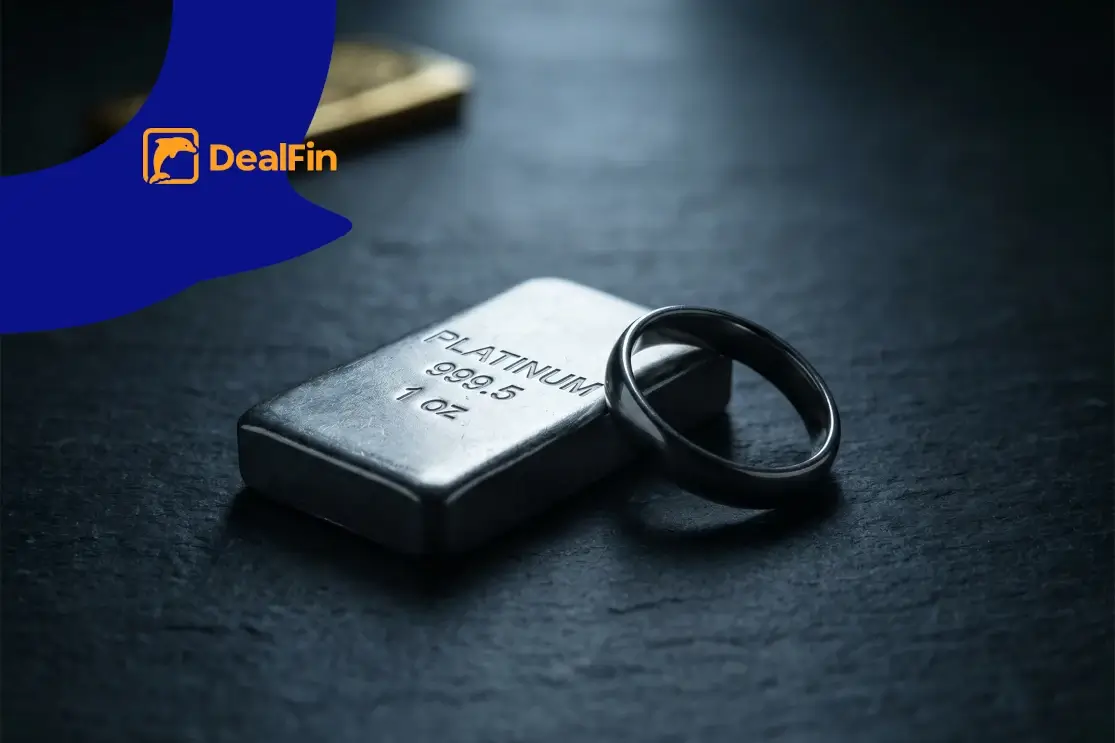
Platinum is one of the rarest and most technically interesting precious metals. At first glance, it resembles silver, but in reality it is significantly denser, more chemically resistant and found in the Earth’s crust only in very small quantities.
This combination of rarity, elegant appearance and exceptional catalytic properties has made platinum a material used at the same time in luxury jewellery, automotive catalytic converters, medicine and modern industry.
However, the simple rule that a rarer metal must automatically be more expensive does not apply. In 2026, platinum trades at a significantly lower price than gold, and its value responds not only to investment demand but also to developments in the automotive industry and mining in South Africa.
In this article, we will explain what platinum is, what properties it has, how it differs from white gold and for whom investment platinum may be worth considering.
What Is Platinum?
Platinum is a silvery-white precious metal with the chemical symbol Pt and atomic number 78. It belongs to the platinum group metals, or PGMs, which also include palladium, rhodium, iridium, osmium and ruthenium. Platinum metal is exceptionally dense, malleable, ductile and relatively unreactive, and it normally does not oxidise in air.
Europeans became more familiar with platinum in the 18th century after discoveries in South America. Its name comes from the Spanish word platina, meaning “little silver”. For a long time, processing the metal was difficult because of its high melting point.
According to the WPIC outlook, platinum mine production in 2026 is expected to reach approximately 5.55 million troy ounces, or about 173 tonnes. That is an order of magnitude lower than annual gold production. Most platinum comes from South Africa, which means supply is highly concentrated geographically.
Properties of Platinum
| Parameter | Value |
| Chemical symbol | Pt |
| Atomic number | 78 |
| Density | 21.4 g/cm³ |
| Melting point | 1,768 °C |
| Colour | silvery white |
| Corrosion resistance | exceptionally high |
| Hardness of pure metal | approximately 3.5 to 4 on the Mohs scale |
Platinum stands out for its density, ductility and resistance to oxidation and most chemicals. It can be shaped without cracking easily and tolerates high temperatures well, which is why it is widely used in laboratories and industry.
Pure platinum is not extremely hard. Jewellery alloys therefore contain additional metals to improve durability. When scratched, the material tends to shift rather than disappear, and the surface gradually develops a soft patina. High-purity platinum alloys are often suitable for sensitive skin, although it is still worth checking the full composition of the jewellery.
Is Platinum More Expensive Than Gold?
In July 2026, no. On 20 July, the spot platinum price was approximately $1,592 per troy ounce, while gold traded at around $4,011. Gold was therefore about 2.5 times more expensive. These values change continuously and can be followed through platinum price charts or LBMA data.
The platinum vs gold ratio changes significantly over time. Before the 2008 financial crisis, platinum often traded above gold. It was later weakened by recession, the decline of diesel engines and changing demand for catalytic converters, while gold benefited from its role as a safe-haven asset.
Platinum prices are therefore more closely linked to industrial demand and tend to be more volatile. They are influenced by vehicle production, catalyst recycling, mining in South Africa, the US dollar and investors. WPIC expects a fourth consecutive market deficit in 2026, but that does not guarantee price growth.
Platinum vs White Gold: What Is the Difference?
White gold is an alloy of gold with metals that give it a lighter colour, such as palladium, silver or nickel. It is often coated with rhodium, which enhances its white appearance, but the coating can wear away over time.
Platinum jewellery most commonly contains 950 parts platinum out of 1,000. The metal is naturally white, so it generally does not require rhodium plating. Another important property of platinum is its higher density, which means a platinum ring of the same size will feel noticeably heavier.
For wedding rings, neither option is universally better. Platinum offers a stable natural colour and high purity, but it is usually heavier and more expensive to work with. White gold is lighter and often cheaper, but it may require re-plating with rhodium over time. The key factors are the purity marking and a valid hallmark, not the colour alone.
Where Is Platinum Used?
The automotive industry remains the largest consumer of platinum. According to the WPIC forecast, vehicles are expected to account for nearly 39% of platinum demand in 2026, mainly through catalytic converters that reduce harmful substances in exhaust gases.
Other major uses include:
- Jewellery: wedding and engagement rings, watches and premium jewellery.
- Medicine: platinum is used in electrodes and some implants, while platinum compounds such as cisplatin are used in the treatment of certain cancers.
- Electronics: durable contacts, sensors, components and, historically, coatings in hard disk drives.
- Chemical and petroleum industries: catalysts that accelerate reactions without being consumed themselves.
- Laboratories and measurement: crucibles, electrodes, resistance thermometers and thermocouples for high-temperature applications.
- Hydrogen technologies: catalysts used in some fuel cells and electrolysers.
Platinum Purity and Hallmarks
Platinum purity indicates how many parts of pure platinum are present in one thousand parts of the alloy. A 950 mark means the product contains 95% platinum. Investment bars and coins usually have a fineness of at least 999 or 999.5, while jewellery commonly uses stronger alloys.
| Purity | Platinum content | Typical use |
| 999 | 99.9% | investment platinum and some coins |
| 950 | 95.0% | premium jewellery |
| 900 | 90.0% | jewellery |
| 850 | 85.0% | jewellery |
Authenticity cannot be reliably determined by colour or with a magnet alone. Check the purity number, the Pt marking and a recognised hallmark. The Czech Assay Office lists the legal fineness standards of 999, 950, 900, 850 and 800 parts per thousand and publishes an overview of valid hallmarks. For more expensive items, it is also worth verifying the origin and accompanying documentation.
Platinum Price: What Does It Consist Of?
The starting point is the spot platinum price in US dollars per troy ounce, which weighs 31.1035 grams. At a price of $1,592 per ounce on 20 July 2026, the metal itself was worth approximately CZK 1,082 per gram. The Czech National Bank exchange rate was CZK 21.182 per US dollar.
However, the spot price is not the same as the retail price of a platinum bar. In the Czech Republic, physical platinum is subject to 21% VAT. The special VAT exemption applies only to investment gold that meets the legal requirements. Manufacturing, transport and dealer margins are also added to the final price. Smaller bars usually carry a higher premium per gram.
The exchange rate also matters. A weaker Czech koruna against the US dollar can increase the platinum price in CZK, while a stronger koruna can reduce it.
Investment Platinum: Is It Worth It?
Investment platinum can serve as a smaller addition to a precious metals portfolio. It is exceptionally rare, and its value depends largely on industrial use. Compared with gold, however, platinum tends to show greater price fluctuations, lower liquidity and, when buying physical metal, a tax disadvantage.
Advantages of investment platinum:
- Exceptional rarity: Platinum is one of the rarest major precious metals. Its annual mine production is significantly lower than gold production and is concentrated mainly in South Africa.
- Strong industrial demand: A significant share of consumption comes from automotive catalytic converters. Platinum is also used in the chemical industry, medicine, electronics and hydrogen technologies.
- Potential for price growth: Limited supply and a possible long-term market deficit may support the platinum price. Growth, however, is not guaranteed.
- Portfolio diversification: Platinum reacts to different factors than gold. Investment platinum can therefore broaden the commodity portion of a portfolio.
Disadvantages of investment platinum:
- High volatility: The platinum price usually fluctuates more than the gold price because it is strongly influenced by the economic cycle and industrial demand.
- Dependence on the automotive industry: The expansion of battery electric vehicles represents a long-term risk. Hybrid vehicles and stricter emissions standards may, on the other hand, support demand.
- Lower liquidity: The platinum market is smaller, and physical bars or coins may be harder to sell, often with a wider difference between purchase and buyback prices.
- 21% VAT: Physical investment platinum is subject to VAT in the Czech Republic. Investment gold that meets the legal conditions is exempt from this tax.
How can you invest in platinum? The basic options are platinum investment bars and bullion coins, such as the Platinum Maple Leaf or Wiener Philharmoniker Platinum. An indirect alternative is exchange-traded products such as ETFs and ETCs linked to the platinum price. When comparing them, investors should consider fees, the method of metal backing, liquidity and currency risk.
Frequently Asked Questions About Platinum
No. As of 20 July 2026, platinum cost approximately $1,592 per ounce, while gold traded at around $4,011. However, the ratio between the two changes over time.
Platinum is a precious metal with the chemical symbol Pt. It is used mainly in automotive catalytic converters, jewellery, the chemical industry, medicine, electronics and hydrogen technologies.
Platinum is a naturally white metal, and jewellery usually contains 85% to 95% platinum. White gold is an alloy of gold with other metals and often has a rhodium-plated surface.
Investment platinum most commonly has a fineness of 999 or 999.5, meaning it contains at least 99.9% pure metal. The specific value is stamped on the bar or coin and stated in the manufacturer’s documentation.
Rather than serving as a complete replacement for gold, platinum is better viewed as a more dynamic addition to a portfolio. It offers potential for price growth, but also comes with higher volatility, lower liquidity and, in the case of physical platinum in the Czech Republic, 21% VAT.
Platinum is an interesting alternative, but gold remains the foundation of a stable precious metals portfolio. Explore our articles about investment gold, its prices and the different ways to buy gold bars and coins.